
Asset Owner Receives the Assessment
The process begins with the person who actually knows the system — the asset owner. They receive a plain-English interview designed around how they think about their work, not how a security framework describes it.
What This Covers
- No cybersecurity background required
- Questions framed in operational, business language
- Covers access, data sensitivity, availability, vendor dependencies
- Takes 20–40 minutes per application
The Difference in Approach
Traditional Assessment Asks
"Rate your exposure to lateral movement attacks on a scale of 1–5"
NORA Asks
"Is this system accessible from outside your network, and do you know for certain your firewall rules are current?"
NORA Conducts a Structured Interview
NORA guides the asset owner through a structured conversation, asking follow-up questions based on their answers. Every response is mapped to the risk domains that security teams need — Likelihood, Impact, and Exposure.
- Adaptive follow-up questions based on prior answers
- Covers all relevant risk domains without jargon
- Captures nuance that checkbox questionnaires miss
- Flags gaps and uncertainties as explicit risk signals
Business Knowledge Is Translated Into Risk Data
This is the core of what makes NORA different. The asset owner's answers — given entirely in business language — are automatically translated into the structured risk data that GRC professionals and auditors need.
- Likelihood score derived from operational context
- Impact score grounded in actual business consequences
- Exposure score reflects control confidence, not just existence
- Every score traceable back to specific asset owner statements
The Translation in Action
Asset Owner Said
"We only let a few people in from our office network, and I think the firewall is set up right but IT handles that"
Becomes Structured Risk Data
Impact scored by data type and user count. Exposure flagged as High because "I think" indicates control confidence cannot be established.
Security Teams Receive Audit-Ready Output
GRC professionals and auditors receive a complete, defensible risk assessment — not raw interview transcripts, but structured, scored, and narrated output that meets audit requirements without any additional translation work.
What the Security Team Receives
- Composite risk score across Likelihood × Impact × Exposure
- Narrative explanation written in audit-ready language
- Compliance mapping to SOC 2, ISO 27001, PCI DSS, HIPAA, NIST CSF, and CSA CCM
- Full traceability: every score tied to source responses
What Gets Delivered
Scored Risk Assessment
L×I×E composite score from 1–125 with severity classification and full methodology
Audit-Ready Narrative
Plain-English risk narrative traceable to specific asset owner statements
Framework Compliance Mapping
SOC 2, ISO 27001, PCI DSS, HIPAA, NIST CSF, and CSA CCM readiness derived automatically
Inside NORA
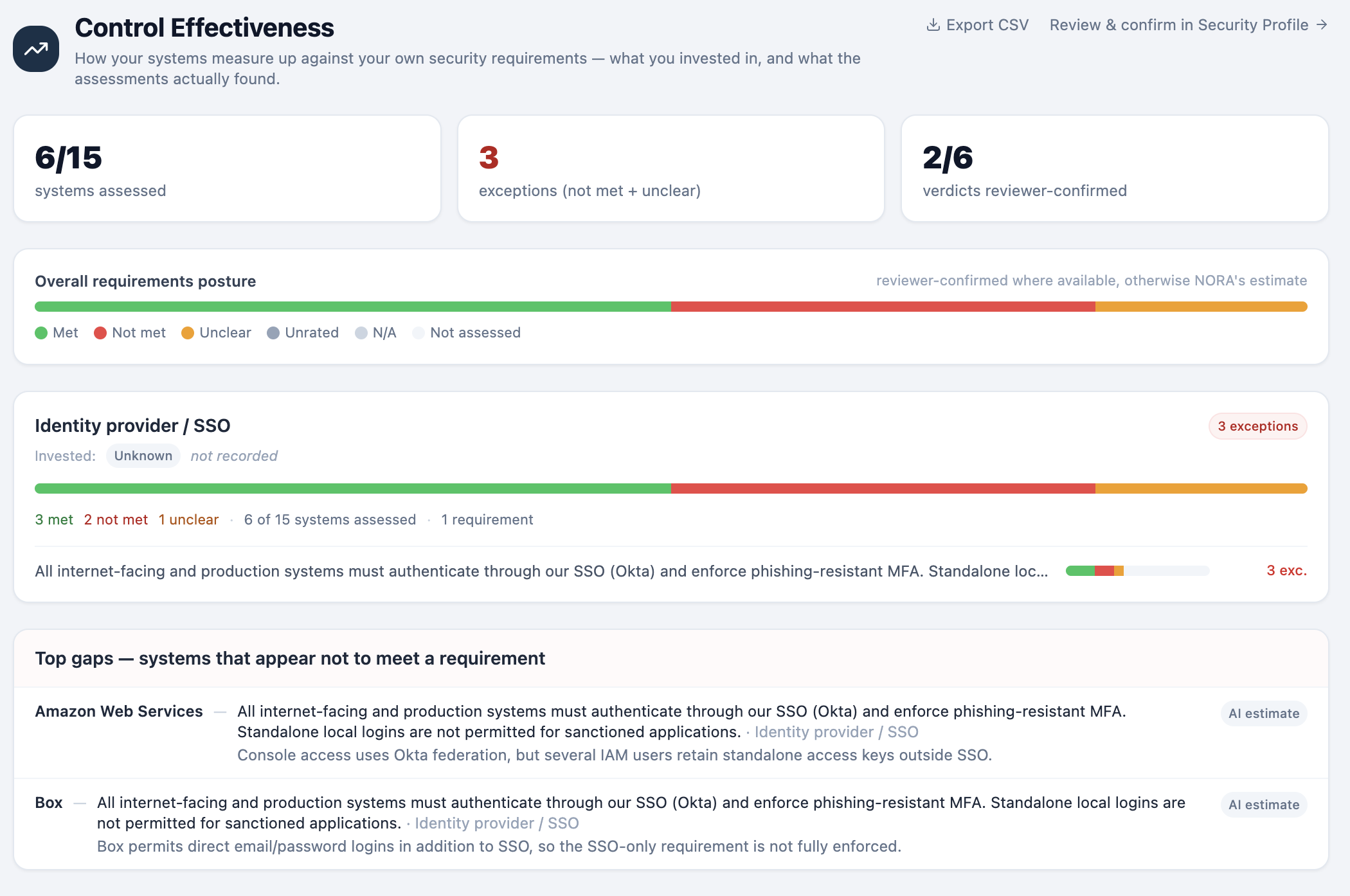
Control effectiveness at a glance: every system measured against your own security requirements — what you invested in, and what the assessments actually found.
The Same Method, Three Assessments
You just saw a risk assessment. NORA applies the identical guided approach — a plain-English conversation, structured and translated — to every question your organization has to answer about its systems.
Risk Assessment
Is this system safe enough?
Vendor Assessment
Can we rely on this service provider?
Business Justification
Should we keep this asset, and how do we govern it?